
Built Together.
Your Offroad Partner.
Your Offroad Partner.
Your Offroad Partner.
Your Offroad Partner.

Ford Ranger lift-kit selection is matching suspension height, damping, and fitment to your truck with the aim of retaining useful towing manners while improving trail clearance. This 2026 guide prioritizes daily ride comfort, loaded stance, and vehicle-specific requirements—not the tallest kit.
A Ranger that commutes, pulls a trailer, and travels uneven trails needs suspension that works under different loads. An empty-truck stance tells you little about how the same truck sits with passengers, camping gear, and trailer tongue weight.
Choose the least ride-height change that meets your documented clearance needs. Additional height introduces fitment, alignment, and hitch-setup questions; it is not proof of better ride quality or towing control.
Iron Ridge Offroad sells aftermarket suspension and other off-road parts for US truck and SUV owners. For a tow-and-trail build, start with your vehicle details and loaded measurements before comparing hardware.
A lift changes suspension position. It does not change the ratings on your truck’s certification label or make an overloaded trailer combination acceptable. Keep the vehicle’s payload, axle, tire, hitch, and towing limits separate from the suspension decision.
Start with your registration, vehicle labels, owner’s manual, and photographs of the existing suspension. Record the model year, drivetrain, trim, and any previous modifications. For a 2026 Ford Ranger, require an application listing that explicitly includes your configuration.
Do not transfer fitment from another Ranger generation, a different market, or a Ranger Raptor. A shared model name does not establish shared suspension hardware. Likewise, a kit for another Ford truck is not a substitute for a Ranger-specific application.
Build a written vehicle profile before contacting a seller. This prevents a conversation about lift height from skipping the details that determine whether the parts belong on your truck.
Use a tape measure on level ground before buying parts. Measure vertically from each wheel-hub center to the corresponding fender reference point. That gives you 4 corner measurements without using tire diameter as the ride-height reference.
Repeat the measurements with your normal passengers, cargo, and properly connected trailer. Follow the towing instructions for your specific truck and hitch arrangement. Record the loading conditions so you can repeat the comparison after installation.
A front leveling kit reduces front-to-rear height difference when unloaded. If your truck already loses substantial rear height with its normal trailer, removing that unloaded rake deserves scrutiny. Address loading and capacity first; do not use suspension height to disguise excessive load.
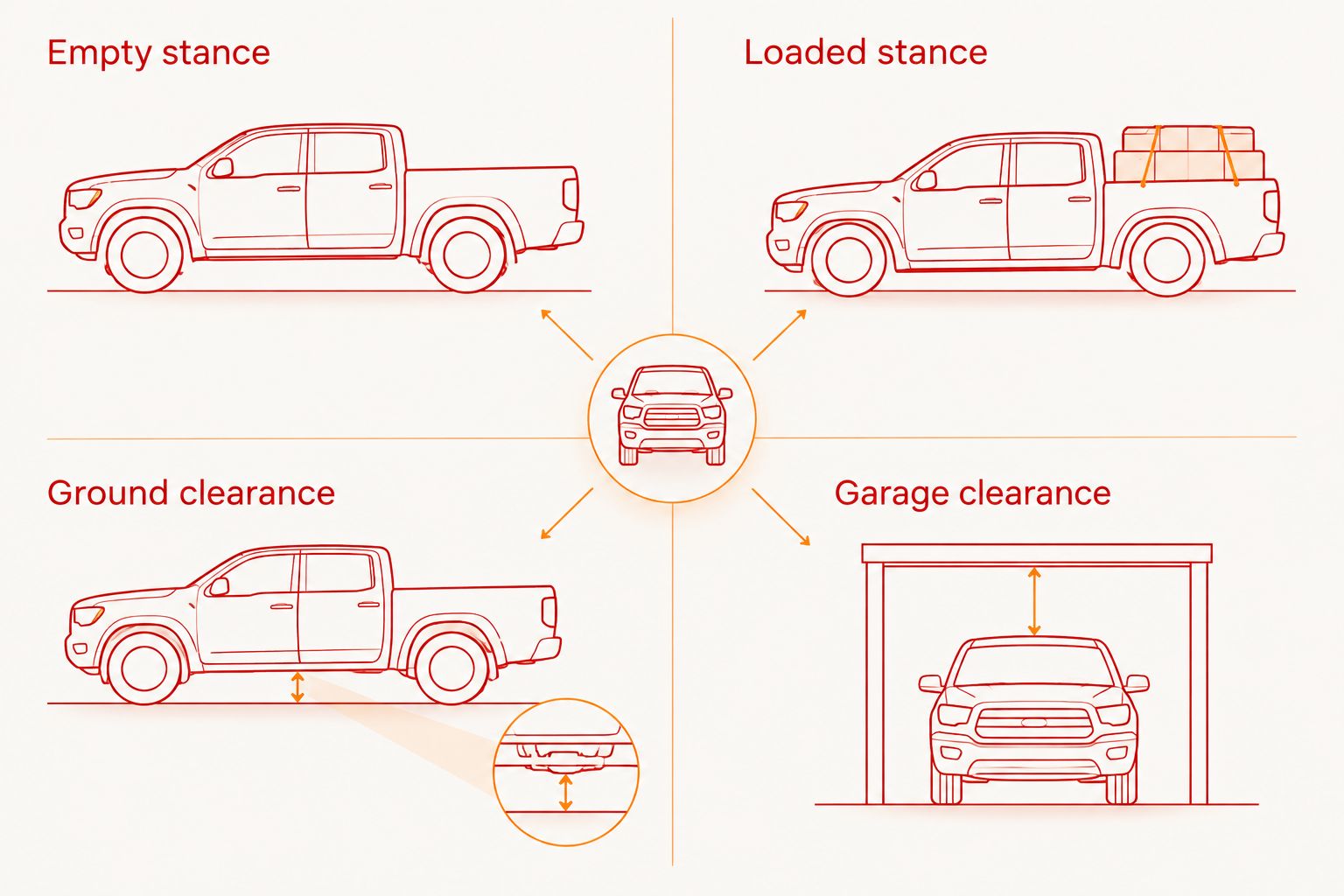
Start by separating appearance, clearance, ride control, and load support. These are different jobs. A spacer changes suspension position; it does not replace worn dampers. A rear load-support system addresses loaded behavior, not front suspension clearance.
For a daily driver, compare how much of the original suspension remains and what the replacement components change. A matched spring-and-damper system addresses more than stance, but its spring choice still needs to suit the weight you carry. Do not assume a spring intended for permanent accessory weight will suit an otherwise lightly loaded truck.
Use Iron Ridge Offroad’s suspension selection as the shopping stage after defining those needs. Compare any candidate against its own application and installation information rather than treating a brand name as fitment verification.
Read the installation instructions before purchasing a Ford Ranger lift kit. Identify required supporting components, alignment provisions, and any restrictions involving factory equipment. A short product title is not an installation plan.
Lift height alone does not establish tire clearance. Tire width, wheel offset, steering position, and suspension compression all affect interference. A tire that clears while parked can contact surrounding components while turning or moving through suspension travel.
For your 2026 build, keep the wheel-and-tire decision tied to the exact kit instructions. Do not copy another owner’s tire size without checking wheel specifications, trim differences, and any trimming that owner performed.
Measure the trailer connection again after changing truck height. Your previous ball-mount position is not automatically correct once the truck’s stance changes. Set up the trailer according to its instructions and the towing guidance for your exact Ranger.
Use a public vehicle scale to verify loading rather than judging capacity by how level the combination looks. Obtain 2 weigh tickets—one for the loaded truck alone and another for the connected combination—and use the scale’s axle readings and the applicable towing instructions to assess the setup.
Rear suspension aids do not increase the ratings of the truck, tires, wheels, or hitch. If the combination exceeds a limit, reduce or redistribute the load within the manufacturer’s instructions. Do not buy a suspension accessory to make an overload look acceptable.
Have the installation checked against the kit manufacturer’s instructions, including fastener procedures and required follow-up inspections. Arrange alignment after the suspension work. Keep the installation instructions and alignment record with your vehicle information.
Evaluate the truck unloaded first, then with its normal towing load in a suitable, controlled setting. Do not start with a long highway trip or a difficult trail. Investigate pulling, vibration, rubbing, repeated bouncing, or unexpected warning messages before continuing.
For a 2026 daily-driver build, success means the truck still performs its everyday jobs without unresolved fitment problems. Extra fender clearance is not a complete result if the truck has lost predictable steering or usable loaded stance.
The right option solves a measured problem without adding unnecessary changes. Compare the scope of each approach, not just its advertised height. None of these options removes the need to confirm Ranger-specific fitment.
| Option | Best for | Main advantage | Key limitation |
|---|---|---|---|
| Keep factory ride height | Owners whose current clearance meets their needs | Avoids lift-related geometry and hitch-height changes | Leaves existing clearance limits unchanged |
| Front spacer leveling kit | Owners correcting a documented unloaded front-height difference | Changes stance while retaining much of the existing suspension | Does not renew damping and reduces unloaded rake |
| Matched spring-and-damper lift | Owners seeking a height change with coordinated suspension components | Addresses spring and damping selection together | Spring choice must match actual vehicle weight and use |
| Replacement dampers at existing height | Owners addressing worn or unsuitable damping without seeking lift | Targets motion control without making lift the objective | Does not itself establish additional clearance |
| Compatible rear load-support system | Owners managing legal, variable rear loads | Addresses rear support under changing loads | Does not increase payload or towing ratings |
A complete lift system is not automatically the best answer for an occasional trail trip. Conversely, a simple leveling kit is not a damping upgrade merely because the truck sits higher.
For a Ford Ranger lift-kit purchase through Iron Ridge Offroad, use this table to define the job first, then verify the exact part number. Do not substitute an F-150, Bronco, or another pickup’s kit for a Ranger application.
A level parked stance is an appearance target, not a towing specification. Removing front-to-rear rake without checking your normal trailer load ignores how the truck is actually used. Measure both conditions before selecting height.
Repeated bouncing and poor motion control call for inspection, not an automatic lift purchase. Check component condition and the intended damping application. A spacer alone does not replace a shock absorber’s function.
Matching tire diameter is not enough. Different wheel width, offset, trim equipment, and suspension parts change the clearance question. Verify your complete combination instead of treating a parked photograph as a fitment check.
A truck that sits level can still exceed a rating. Check 3 separate limits at minimum: vehicle payload, axle ratings, and hitch ratings; tire and towing limits also apply. Load-support hardware is not permission to exceed any of them.
A changed truck stance requires a fresh towing-setup check. Reusing the old ball-mount position without measuring trailer attitude leaves an essential part of the modification unfinished. Check the loaded combination, not just the unhitched truck.
What’s the best Ford Ranger lift kit for towing and trails?
The best Ford Ranger lift kit is the exact-fit system that meets your measured clearance needs while retaining appropriate loaded stance and suspension control. Compare leveling and matched suspension systems against your vehicle configuration, normal load, and the manufacturer’s instructions.
Does lifting a Ford Ranger increase towing capacity?
No, a suspension lift does not increase a Ford Ranger’s towing capacity or payload rating. Keep the truck, axle, tire, wheel, and hitch limits in force after modification.
Is a leveling kit better than a full suspension lift for a daily driver?
A leveling kit is appropriate when front ride height is the specific problem; a matched suspension system addresses a broader spring-and-damper change. Neither is automatically better for every daily driver, and unloaded appearance does not establish towing suitability.
Will a Ranger lift kit fit every model year and trim?
No, Ranger lift-kit fitment must be confirmed for the exact model year, drivetrain, trim, and existing suspension. Do not transfer fitment between generations, market versions, or Ranger Raptor and other Ranger configurations.
Can I fit larger tires just by adding a lift?
A lift alone does not guarantee clearance for larger tires. Verify tire dimensions, wheel width and offset, steering-lock clearance, and clearance through suspension compression against the kit’s instructions.
Do I need to change my hitch setup after lifting my Ranger?
You need to recheck hitch setup after changing your Ranger’s ride height. Measure the loaded truck and trailer on level ground, then follow the truck, trailer, and hitch instructions for the finished combination.
Can rear air helpers fix an overloaded Ranger?
No, rear air helpers do not make an overloaded Ranger acceptable. Verify the exact application and reduce or redistribute load within the manufacturer’s instructions whenever a rating is exceeded.
Before ordering your 2026 suspension setup, photograph the Ranger hitched to its normally loaded trailer on level ground. Keep that photograph beside the corner measurements and weight records. It gives you a useful baseline for evaluating the finished truck—not just its empty parking-lot stance.