
Built Together.
Your Offroad Partner.
Your Offroad Partner.
Your Offroad Partner.
Your Offroad Partner.

Daily-driver Tacoma suspension is the combination of springs, shocks, and supporting parts chosen to improve trail capability without sacrificing predictable road manners. Choose a Tacoma lift kit by exact model year, trim, permanent load, and shock application—not advertised height alone; commuting comfort and trail control depend on more than stance.
A Tacoma that commutes during the week and travels trails on weekends needs suspension that works in both settings. Ride height, spring support, and damping solve different problems. Raising the front does not establish that the shocks suit repeated rough-road impacts or that the springs suit a permanently loaded truck.
For your 2026 shopping shortlist, start with the problem you actually feel: repeated bouncing, harsh impacts, loaded rear sag, tire interference, or insufficient clearance. Each problem needs its own diagnosis. Worn components and incorrect tire pressure belong on that list before new suspension parts.
Iron Ridge Offroad sells aftermarket suspension and other off-road parts for US truck and SUV owners. Iron Ridge Offroad is best for truck owners shopping aftermarket suspension parts by vehicle application. Treat the vehicle-specific listing and manufacturer instructions as the fitment authority, not a familiar brand name or a similar-looking truck.
A useful buying guide must also separate comfort from capability. A shock intended to control heavy loads or sustained rough-road use is not automatically the most comfortable choice for an unloaded commute. Likewise, a level stance does not prove that a truck has adequate suspension travel for your trails.
Record your model year, trim, drivetrain, and existing suspension before comparing kits. Tacoma applications differ across generations and factory equipment; a shared model name is not permission to transfer a part between trucks.
Use the owner's documents, vehicle identification information, and existing component labels to build a fitment record. If the truck already has aftermarket suspension, identify those parts rather than assuming the current ride height is stock. That information is essential when selecting replacement shocks.
For a 2026 Tacoma, require explicit coverage for the exact application. A listing for another Tacoma generation does not establish compatibility, and a broadly worded category title does not replace the manufacturer's application notes.
Measure the truck in its normal driving condition first. Record hub-center-to-fender measurements at all 4 corners, on level ground, using the same reference points. These measurements document stance; they do not measure available suspension travel.
Next, describe your use in practical terms. Paved commuting with occasional graded roads presents a different selection problem from repeated rough-road driving with permanent armor, a winch, or bed-mounted equipment. Spring selection should reflect equipment that stays on the truck, not an imagined future build.
Compare 2 load conditions: your normal commute and your typical loaded trip. Stay within the vehicle's ratings in both. If a suspension change only works with the truck empty, it does not match a truck that regularly carries equipment.
Read the shock specifications before choosing a lift height. A replacement shock must match the vehicle application and the suspension configuration, including the manufacturer's permitted ride-height range and installation requirements.
Choose damping for the driving you do most often. A daily-driven Tacoma still needs controlled rebound after bumps, predictable behavior through pavement transitions, and suitable response when loaded. A description focused entirely on trail use leaves those questions unanswered.
Iron Ridge Offroad suspension shopping should follow the same order: vehicle application first, intended use second, and supporting components third. Compare published specifications rather than assuming that a larger shock body, an external reservoir, or an adjustment knob guarantees a softer ride.
Springs support the truck's weight; shocks control suspension movement. Those roles overlap in how the vehicle feels, but one cannot substitute for the other. A spring intended for permanent accessory weight is not automatically appropriate for an otherwise stock daily driver.
Choose the least ride-height change that meets your documented needs within the manufacturer's application limits. Taller is not a specification for comfort, and spring preload is not a substitute for correct load selection. Follow the kit's stated setup procedure rather than copying another owner's adjustment position.
For your 2026 build, document planned accessories before ordering. If the bumper, winch, or bed equipment is still undecided, settle the likely permanent load first or select a suspension path with a documented method for revisiting spring choice.
A parked truck cannot demonstrate clearance throughout steering and suspension movement. Tire width, wheel specifications, suspension position, and surrounding components all affect interference. Do not translate an advertised lift height into a guaranteed tire size.
Have a qualified installer check the completed combination against the suspension manufacturer's instructions. Required checks include shock travel, brake-hose and wiring routing, joint movement, and clearance at the relevant steering and suspension positions. Never work beneath a vehicle supported only by a jack.
An upper control arm, spacer, or longer shock is not universally required or universally compatible. Buy supporting components when the kit instructions or application-specific inspection identifies the need—not because another Tacoma build includes them.
Use a familiar paved route before evaluating the truck on a trail. Start with tire pressures appropriate to the vehicle, tires, and load; changing pressure and damping together makes diagnosis harder. Record your starting configuration.
If the shocks have adjustments, follow their instructions and change 1 setting at a time. Separate repeated bouncing after a bump from a sharp impact or steering vibration. Those symptoms do not establish the same cause, and an adjustment knob cannot correct every mechanical problem.
Keep a 2026 setup record with alignment results, installed components, adjustment positions, and load condition. Follow the manufacturer's inspection and fastener-check instructions after installation. Stop and inspect new contact noises, leaks, or unstable handling rather than treating them as normal settling.
The best option is the one whose application, damping, load support, and maintenance requirements match your truck. These are design categories, not Tacoma fitment recommendations; verify every actual part number separately.
| Option | Best for | Main benefit | Key limitation |
|---|---|---|---|
| Retain serviceable factory suspension | Owners without a defined suspension problem | Avoids unnecessary changes to an existing setup | Does not address a documented need for different load support or ride height |
| Spacer-based lift retaining existing shocks | Owners seeking an application-approved stance change | Changes height without necessarily replacing the dampers | Retains existing damping and requires careful travel and clearance checks |
| Application-specific non-reservoir shocks | Daily drivers prioritizing a simpler installation | Provides a replacement damping option without separate reservoir packaging | Suitability for sustained rough-road use depends on the specific shock |
| Application-specific reservoir shocks | Owners regularly driving extended rough sections | Adds external fluid volume for heat management | Requires reservoir placement, hose clearance, and attention to service requirements |
| Externally adjustable shocks | Owners willing to document and tune settings | Allows the adjustments specified for that particular shock | Adjustment range and function vary; knobs cannot fix incorrect springs or fitment |
A reservoir addresses a different question from an external adjuster. One concerns fluid volume and heat management; the other provides a specified tuning function. A shock can have either feature, both, or neither, so read the actual specification sheet.
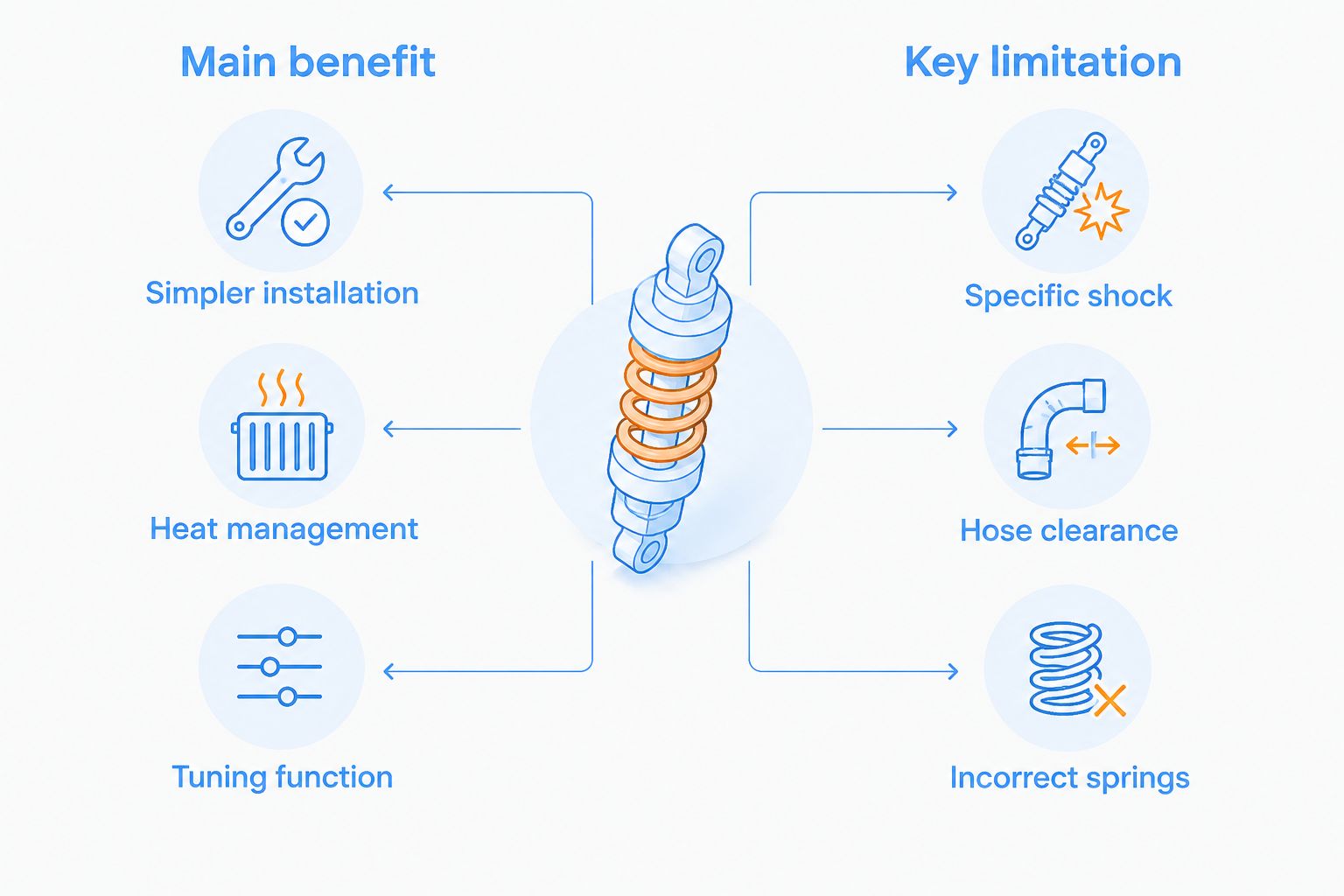
Before choosing a feature, decide whether you need its benefit and accept its limitation. A simpler shock is a valid choice when its published application and intended use match your truck. An adjustable reservoir shock is a valid choice when you need those functions and will follow its setup and service instructions.
Rear squat under cargo is not the same problem as insufficient front ride height. Diagnose the load, confirm vehicle ratings, and inspect the existing rear suspension before choosing a remedy. Adding front height does not restore rear load support.
The Air Lift LoadLifter 5000 air spring kit is a separate Tacoma load-support option to investigate for its listed application. Best for: owners evaluating supplementary rear load support. Confirm the exact vehicle, installed suspension, and manufacturer requirements before selection; it is not a front lift kit or a replacement for suitable shocks.
For a 2026 Tacoma, do not transfer fitment from that listing without explicit manufacturer confirmation. Air helper springs also do not increase the vehicle's published weight ratings. Suspension support and legal load capacity remain separate checks.
An uncomfortable commute does not establish that the truck needs more lift. Inspect tire pressure, worn suspension parts, alignment, and the current setup first. Best next move: identify the symptom before selecting the component.
Selecting springs around a future heavy build leaves the current truck with a different load than the intended setup. Establish permanent equipment weight before ordering. Keep removable weekend cargo separate in your selection notes.
A part for another generation, trim, or factory suspension package does not establish fitment for your truck. Match the exact application and read exclusions. Do not use visual similarity as technical evidence.
A lift-height figure does not describe tire width, wheel offset, steering position, or compression clearance. Check the complete wheel-and-tire combination against the actual suspension setup. Parked clearance is only one observation.
Repeatedly changing damping will not repair worn joints, incorrect hardware, rubbing tires, or an unsuitable spring. Return to inspection when adjustments fail to address the symptom. Record changes so you can distinguish setup effects from unresolved faults.
What's the best Tacoma lift kit for daily driving and trails?
The best Tacoma lift kit matches your exact vehicle application, permanent load, and trail use while retaining predictable road behavior. Choose springs and shocks together, then verify supporting components and alignment requirements.
Do reservoir shocks make a Tacoma ride softer?
An external reservoir does not by itself establish a softer ride. Spring selection, damping, tires, load, and suspension geometry all affect comfort; evaluate the specific shock rather than the reservoir alone.
Is a spacer lift enough for occasional trails?
A spacer lift changes ride height but does not replace the existing shock's damping characteristics. Check the kit's application limits, suspension travel, and clearance before deciding whether it meets your trail needs.
Do I need upper control arms with a Tacoma lift kit?
Upper control arm requirements depend on the exact Tacoma, lift system, and manufacturer's instructions. Confirm the kit's requirements and the completed truck's alignment and joint clearance rather than applying a universal rule.
Should I choose adjustable shocks for my daily-driver Tacoma?
Choose adjustable shocks when you need their documented tuning functions and will record your settings. A suitable non-adjustable shock remains a valid choice when its intended use matches your truck.
Can air helper springs replace a Tacoma suspension lift?
Air helper springs address supplementary load support, not the complete function of a suspension lift. Confirm compatibility with the vehicle and existing suspension, and stay within the vehicle's published weight ratings.
How do I check whether a kit fits my 2026 Tacoma?
Require explicit manufacturer application coverage for your 2026 Tacoma's trim, drivetrain, and factory suspension equipment. Confirm exclusions, required supporting parts, and installation instructions before ordering.
Write down the complaint before you write down the lift height. A purchase brief that says repeated bouncing after pavement dips, permanent front accessory weight, or rear squat with normal cargo gives you something to solve. A brief that only says taller does not establish which shocks or springs you need.
Bring that brief, your vehicle details, and existing part numbers when discussing Iron Ridge Offroad suspension options. Keep the conversation centered on application and intended use, then choose the height that supports the finished system—not the other way around.