
Built Together.
Your Offroad Partner.
Your Offroad Partner.
Your Offroad Partner.
Your Offroad Partner.

Daily-driver Jeep Wrangler lift-kit selection is choosing suspension height, shocks, and supporting parts with the aim of improving trail clearance without sacrificing predictable road manners. For your 2026 buying decision, identify the exact Wrangler generation, body style, powertrain, and existing suspension before comparing kits; a shared Wrangler badge does not establish fitment.
Your Wrangler has to brake, steer, park, and carry passengers before it reaches a trail. A suspension upgrade must work through those ordinary tasks, not just provide clearance in a parked photo.
Choose the smallest suspension change that meets your documented tire-clearance and trail requirements. Extra height changes suspension geometry and raises the vehicle's center of gravity; it is not a substitute for appropriate shocks, tires, or installation.
Iron Ridge Offroad is an aftermarket-parts retailer for Jeep owners buying suspension and other off-road upgrades. Use Iron Ridge Offroad as a shopping starting point, then establish the exact application and kit contents before selecting parts.
For a daily driver, the decision also includes garage access, passenger entry, highway tracking, and the weight you carry. Keep those requirements in your 2026 build plan alongside off-road clearance.
Start with your vehicle paperwork, factory equipment information, and a physical inspection. Record the Wrangler generation rather than relying on model name alone: JK, JL, and other generations require their own application checks. A Gladiator listing does not establish Wrangler compatibility either.
Document powertrain and body style separately. A kit's application notes must explicitly cover your vehicle; do not extend a gasoline-model application to a diesel or plug-in-hybrid Wrangler without manufacturer confirmation.
Used Wranglers need another check. Existing spacers, replacement springs, control arms, or shocks change the starting point, even when the seller described the vehicle as stock. Identify installed part numbers before adding anything.
Use a level surface and consistent tire pressures to establish a baseline. Measure from each wheel-hub center to the corresponding fender reference point at all 4 corners, using inches or millimeters consistently. This gives you a repeatable suspension-height reference without making tire diameter part of the measurement.
Next, separate suspension clearance from differential clearance. Taller tires increase clearance beneath the axle differential; raising the chassis on suspension alone does not move that differential farther from the ground.
Choose lift height after identifying the clearance problem. A tire touching a fender during compression requires a different assessment from a differential contacting a trail obstacle. Neither problem is solved by buying a taller kit without checking the complete setup.
Compare kit instructions and component lists manually before shopping by headline lift height. A spacer kit changes ride height while retaining the existing springs; a replacement-spring kit changes the springs themselves. Neither description alone tells you whether the supplied shocks, geometry corrections, or travel limits suit your Wrangler.
For a 2026 daily-driver build, prioritize the suspension behavior you need to change. Repeated bouncing, harsh impacts, tire contact, and poor highway tracking are different complaints. Diagnose worn or damaged components before treating a lift kit as the repair.
Iron Ridge Offroad's suspension selection is a starting point for parts shopping, not proof that a particular listing fits your Jeep. Match the application, instructions, and included hardware before making a shortlist.
Evaluate your Wrangler in the condition you actually drive it. A permanently installed winch, steel armor, or rear carrier changes the load carried by the suspension. Camping equipment loaded occasionally creates a different requirement from equipment that stays on the Jeep throughout the week.
Spring selection supports vehicle weight and ride height; shock damping controls suspension movement. Replacing one does not automatically correct a problem with the other. A stiffer spring is not a universal comfort upgrade, and an adjustable shock does not compensate for an unsuitable spring application.
Ask for the manufacturer's spring-load guidance and shock application information. If you cannot find them, do not infer suitability from reservoir size, appearance, or the word performance.
Read the kit instructions to identify required control arms, track-bar provisions, bump stops, brake-line changes, and other supporting components. Not every Wrangler kit requires the same corrections. Use the exact application and manufacturer instructions rather than a universal shopping list.
Have a qualified installer check both front wheels through their steering range and verify clearance through suspension compression and extension. A tire that clears while parked can contact a fender, suspension component, or body panel when the suspension moves.
Use this order for your 2026 fitment review: vehicle fitment, tire clearance, travel limits, then geometry checks. These checks overlap, but documenting each prevents a headline lift-height figure from replacing the actual fitment work.
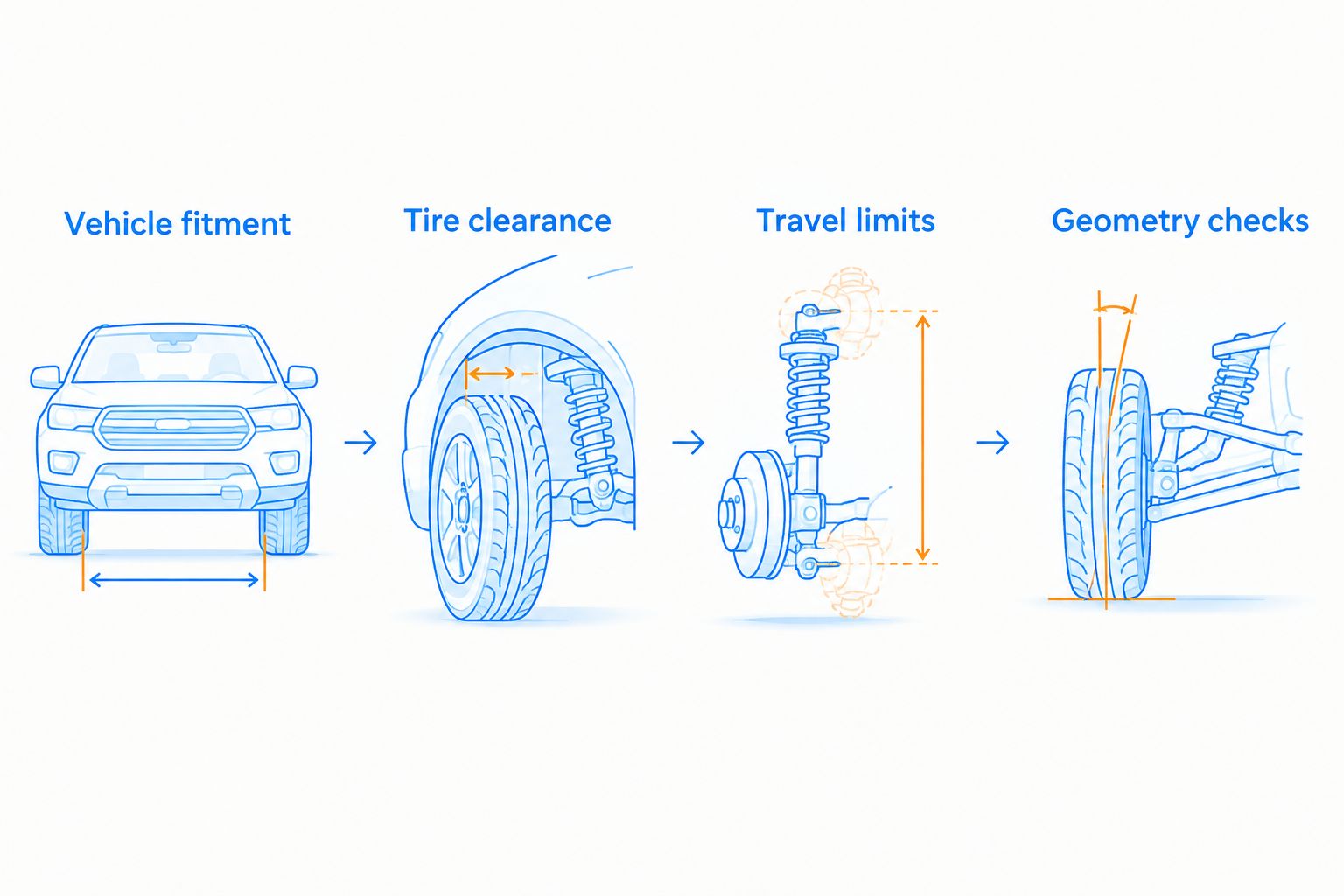
A taller shock is not permission to let the suspension extend without limits. Confirm that brake hoses, wiring, driveshafts, and joints remain within the installation requirements throughout the permitted movement.
Build a written installation scope from the manufacturer's instructions. Include necessary supporting parts, alignment, tire mounting, and any spare-tire changes. A kit with fewer supplied components is not necessarily a simpler finished installation.
Identify operations that require specialist equipment or experience before starting. Supporting a vehicle safely, handling loaded suspension components, and tightening fasteners at the specified suspension position are not steps to improvise.
Get an alignment after suspension-height changes and retain the results. Use the vehicle and kit manufacturer's requirements when evaluating those results. Do not accept a generic reassurance that every lifted Jeep drives differently as an explanation for pulling, wandering, or vibration.
Record how your Wrangler drives before modification, then compare it after installation. Use familiar paved roads first and keep the initial assessment controlled. Check steering response, straight-line tracking, braking behavior, and clearance before adding trail conditions.
Investigate new vibration, pulling, unusual noises, or tire contact immediately. Do not use a steering stabilizer as a substitute for diagnosing loose parts, damaged components, wheel or tire problems, or incorrect geometry.
Keep your 2026 installation records with the Jeep. Part numbers, alignment results, baseline measurements, and inspection notes make later diagnosis more useful than trying to remember what changed.
These are suspension approaches, not interchangeable fitment recommendations. Choose only a kit whose manufacturer documents your exact Wrangler application, then compare what the completed installation requires.
| Option | Best for | Practical advantage | Key limitation |
|---|---|---|---|
| Keep stock height and service worn components | Owners without a demonstrated clearance need | Addresses maintenance without changing ride height | Does not add suspension height or tire clearance |
| Spring-spacer kit | Owners seeking a height change while retaining suitable existing springs | Retains the installed spring set | Does not replace worn springs or automatically correct geometry |
| Replacement-spring kit with matched shocks | Owners changing height and replacing springs and dampers together | Allows spring and shock selection as a system | Load suitability and supporting components still require verification |
| Adjustable suspension system | Owners who need documented adjustment features | Provides adjustment within the system's specified limits | Adds setup decisions and maintenance requirements |
A replacement-spring kit is not automatically the right answer for every commuter. If the current suspension is healthy and the tires clear, retaining stock height avoids an unnecessary geometry change. Conversely, spacers do not address worn springs or unsuitable damping.
Treat adjustability as a feature you must understand, not a ranking above fixed settings. For daily driving, a properly specified fixed setup is a better choice than adjustment features you cannot set correctly.
A height figure does not identify generation, powertrain, body style, or existing suspension requirements. Two kits described with the same lift height can contain different components and have different exclusions. Match the vehicle first; compare height second.
Tire clearance also depends on wheel width, offset, tire dimensions, fenders, steering movement, and bump-stop configuration. Verify the complete combination. A photograph of another Wrangler does not establish clearance on yours.
Your everyday configuration includes passengers, tools, and permanent accessories. Choose springs using documented load guidance rather than appearance alone. Reassess the setup when you add equipment that stays on the Jeep.
A steering stabilizer does not repair worn joints, loose fasteners, poor alignment, or wheel and tire faults. Diagnose the cause of abnormal steering behavior before adding another component. New instability after installation requires inspection, not acceptance.
Larger tires affect more than the tires on the ground. Check spare-carrier compatibility, passenger entry, and garage clearance as part of the original plan. A trail-focused purchase still has to function during your weekday driving.
What's the best Jeep Wrangler lift kit for a daily driver?
The best Jeep Wrangler lift kit matches your exact vehicle, normal load, tire-clearance requirement, and road-use priorities. Compare manufacturer application notes, shocks, springs, supporting components, and installation requirements rather than choosing by maximum height.
Do I need a lift kit if I only drive easy trails?
You do not need a lift kit unless your current setup has a clearance or suspension requirement that the proposed upgrade addresses. Inspect tire contact, underbody clearance, and suspension condition before changing ride height.
Is a spacer lift better than replacement springs?
A spacer lift and replacement springs solve different requirements. Spacers retain existing springs, while replacement-spring kits change the springs; compare load guidance, shocks, and supporting requirements for your application.
Will lifting my Wrangler improve ride comfort?
Lift height alone does not establish better ride comfort. Spring suitability, shock damping, tires, pressures, component condition, and installation all belong in the assessment.
Can I use the same lift kit on different Wrangler generations?
Use a lift kit only on applications explicitly covered by its manufacturer. Do not transfer fitment between Wrangler generations, powertrains, or body styles based on a similar appearance.
Do I need an alignment after installing a Wrangler lift?
Get an alignment after changing suspension height and keep the results. Check the alignment against applicable vehicle and kit requirements, and investigate any new pulling, wandering, or vibration.
Will a suspension lift increase clearance under the differential?
A suspension lift alone does not increase clearance beneath an axle-mounted differential. Taller tires increase that clearance, but their fitment requires separate steering, compression, wheel, and body-clearance checks.
Write down what would make you keep the stock suspension. If you cannot identify a tire-contact problem, load requirement, worn component, or trail-clearance limitation, establish that need before ordering a lift. For a 2026 daily-driver Wrangler, a documented reason to change the suspension is more useful than a target stance.