
Built Together.
Your Offroad Partner.
Your Offroad Partner.
Your Offroad Partner.
Your Offroad Partner.

Your Tacoma lift kit needs upper control arms when the kit manufacturer requires them, the stock arms prevent the required alignment, or the suspension cannot move through its intended travel without joint binding or interference. Lift height alone does not decide the answer. For a daily driver that also sees trails, check the exact vehicle application, alignment requirements, and suspension clearance before ordering arms.
Yes when the suspension system requires them; otherwise, verify alignment and travel before replacing serviceable factory arms. An upper control arm must work with the lift, shock length, steering knuckle, wheel package, and vehicle—not simply share the Tacoma name.
Start with the suspension system rather than choosing arms separately. The guide to Tacoma lift kits for daily use and trails covers the shock-selection side of that decision.
| Decision | Best for | Main advantage | Main limitation |
|---|---|---|---|
| Retain factory upper control arms | A manufacturer-approved setup that meets alignment and clearance requirements | Avoids replacing compatible, serviceable components | Does not add the geometry correction or clearance of a purpose-designed replacement |
| Install compatible aftermarket upper control arms | A lift that requires different geometry, joint operating range, or arm clearance | Addresses the specific requirement the arm was designed to solve | Adds components with their own installation and maintenance requirements |
| Reassess the lift configuration | A combination with unresolved alignment, binding, or interference | Corrects the parts combination rather than treating symptoms | Requires reviewing the system before continuing the build |
For a 2026 Tacoma, confirm that every selected component explicitly covers that model and its suspension configuration. Do not transfer fitment from another Tacoma generation or from a different Toyota platform.
A Tacoma can look level while still having an alignment or suspension-clearance problem. The upper control arms are part of a moving assembly, so a parked inspection cannot establish that the system works throughout its intended operating range.
The buying mistake is treating aftermarket arms as either mandatory for every lift or unnecessary because the truck drives out of the shop. Neither rule checks the actual installation. Approve the complete suspension combination, not its stance.
Iron Ridge Offroad sells aftermarket suspension parts, but that category description is not a Tacoma fitment statement. Match the exact part number to your vehicle and lift before you order.
Best for: daily-driver builds whose lift instructions permit factory arms and whose completed installation passes alignment and clearance checks. Keeping the original arms is a valid decision when they remain suitable for the system. Replacement is not an upgrade merely because the new arm is aftermarket.
Confirm these conditions before retaining the factory parts:
The advantage is straightforward: you retain parts that already satisfy the installation requirements. The limitation is equally important: factory arms cannot supply a geometry or clearance change that the selected suspension specifically needs.
Recommendation: retain compatible factory arms, not questionable factory arms. A worn joint or damaged bushing requires attention regardless of whether you lift the truck.
Best for: Tacoma owners whose selected suspension requires an application-specific arm or whose documented checks identify a problem that arm resolves. Look for the manufacturer's explanation of the arm's purpose. That explanation should address your installation, not just lifted trucks generally.
Depending on their design, replacement arms address alignment geometry, joint operating range, or clearance around suspension components. Those functions are not interchangeable. An arm designed for one need does not automatically solve the others.
Before buying, identify the required benefit in plain language:
The benefit is a component designed around a stated requirement. The trade-off is another set of instructions to follow, including joint inspection, lubrication where specified, and any required service procedures.
Recommendation: buy the arm that solves the documented requirement. Do not select one solely by appearance, material, or a general promise of more travel.
Upper control arm requirements vary because lift height describes only part of the suspension combination. These factors determine what you need to verify:
For a 2026 suspension purchase, save the current application notes and installation instructions alongside the part numbers. A product name is not a substitute for those documents.
Check the instructions first, then alignment and suspension movement. Use a qualified suspension installer for checks that require safely supporting the vehicle or moving the suspension through its travel.
Find the exact lift part number and the manufacturer's application notes. Establish whether replacement arms are required, permitted, or excluded, and check whether the system assumes other supporting components.
Give the installer the vehicle model year, drivetrain, trim, suspension package, and existing modifications. Include the proposed shocks, springs, wheels, and tires so the review covers the assembled truck rather than isolated purchases.
Check the existing arms, bushings, joints, and alignment hardware using the applicable service procedure. Do not use new upper control arms to avoid diagnosing damage or wear elsewhere in the front suspension.
Request the completed alignment measurements against the applicable specifications. If a setting cannot be achieved, identify the limiting condition before assuming that a particular replacement arm fixes it.
Have the installer verify steering and suspension clearance through the required operating range under the manufacturers' procedures. Contact, binding, or an unsuitable joint angle needs correction before the truck returns to service.
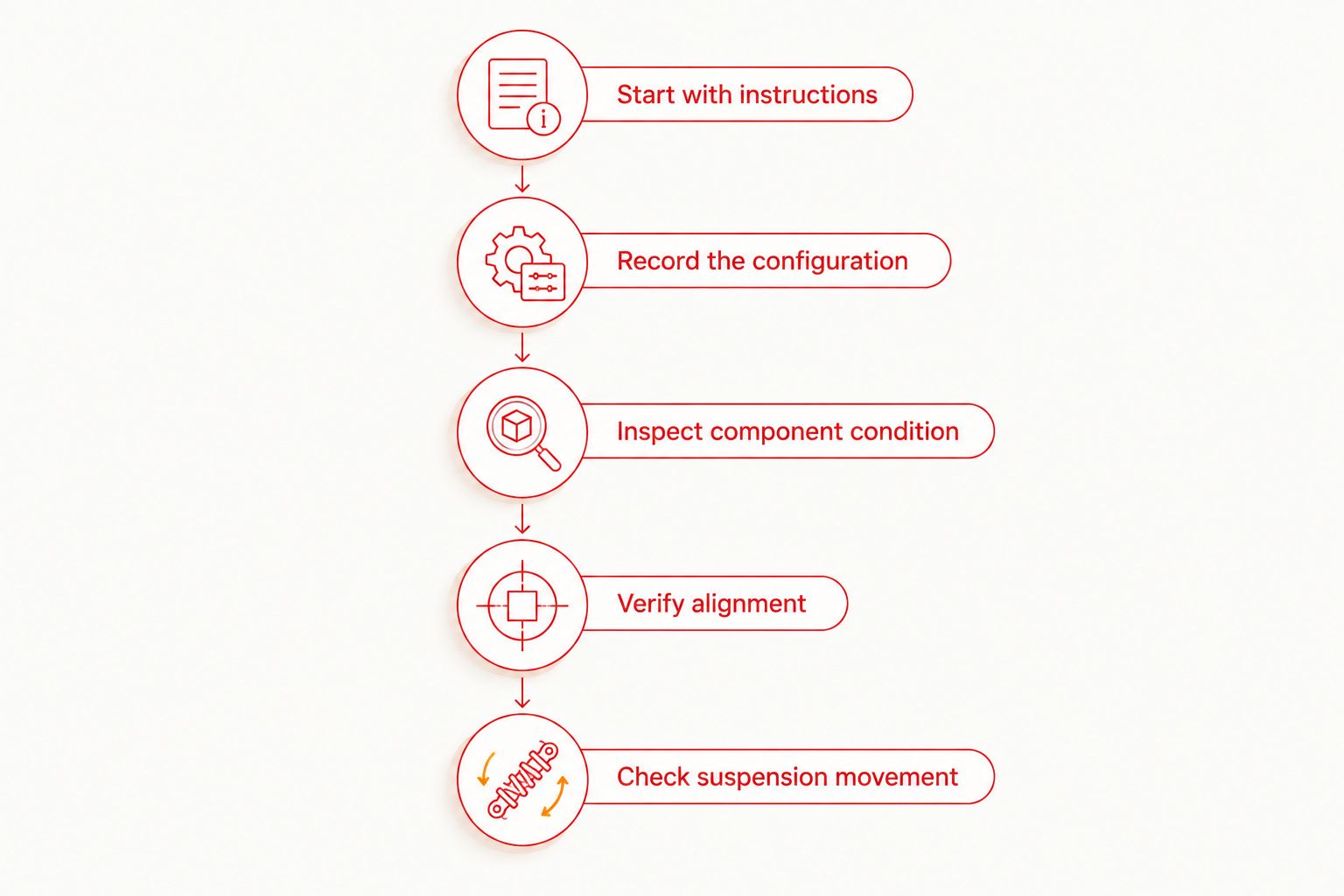
Keep the alignment report and installation notes with your build records. They give the next shop a starting point if you change tire size, add permanent weight, or revise the suspension later.
No universal lift-height cutoff replaces application-specific instructions. A stated height does not identify the arm geometry, shock dimensions, joint operating limits, or alignment adjustment available on your truck.
The same distinction matters when discussing 3-inch lifts on a Hilux: the height describes a proposed change, not proof that the original components remain suitable. A Hilux assessment does not establish Tacoma compatibility, and neither does another owner's successful installation on a different suspension combination.
Avoid buying arms because a forum post names a threshold without identifying the exact parts and vehicle. Ask what the arm changes, why that change is necessary, and which manufacturer documentation covers the combination.
For your 2026 build, treat photographs and owner reports as descriptions of other trucks. Use the specified application and installation requirements to approve yours.
Upper control arms fix tire rubbing only when a compatible arm resolves the actual interference. They are not a general clearance solution for the body, bumper, liner, or every suspension component.
Have the installer locate the contact before ordering parts. Tire-to-arm contact is a different problem from tire-to-body contact, and clearance at straight-ahead ride height does not establish clearance while steering or moving through suspension travel.
Changing wheel offset also changes the package being evaluated. Do not treat it as a universal workaround; review the wheel, tire, suspension, and body clearance together.
Recommendation: identify the contact point first. A replacement arm belongs in the solution only when its documented design addresses that contact without creating another compatibility problem.
Aftermarket upper control arms are not a substitute for suitable springs and damping. Correct geometry and unrestricted movement matter, but an arm purchase alone does not establish better everyday ride comfort.
If your complaint is harshness, describe when it occurs: over small pavement joints, larger bumps, or repeated trail impacts. Have the suspension configuration and component condition assessed rather than choosing arms as the default remedy.
Joint and bushing designs also carry different inspection and service requirements. Compare those obligations before selecting parts for a truck that handles commuting as well as trail use.
Recommendation: diagnose the ride complaint separately from the arm requirement. Buy arms for their specified function and choose springs and shocks for the vehicle's intended use and supported load configuration.
Prepare a short build sheet before choosing Tacoma suspension parts from Iron Ridge Offroad. The goal is a compatible system, not a collection of individually appealing components.
Include:
For a 2026 Tacoma, require explicit 2026 application coverage rather than assuming an earlier listing carries over. If the product title and detailed instructions disagree, resolve that discrepancy before ordering.
Iron Ridge Offroad is an aftermarket-parts retailer for truck and SUV owners, not a substitute for application-specific suspension instructions. Use the retailer to source the correct parts and the manufacturer's documentation to establish their permitted use.
Does every Tacoma lift kit need upper control arms?
No, every Tacoma lift kit does not require replacement upper control arms. Follow the exact kit instructions and retain factory arms only when their condition, alignment, and operating clearance satisfy the installation requirements.
Can I keep stock upper control arms on my lifted Tacoma?
You can keep stock upper control arms when the lift manufacturer permits them and the completed system passes the required checks. Confirm alignment, joint movement, and clearance rather than deciding from lift height alone.
Are upper control arms included with a Tacoma lift kit?
Upper control arm inclusion depends on the exact lift kit. Read the package contents and installation requirements separately, because a required supporting component is not necessarily included.
Will new upper control arms stop my Tacoma tires from rubbing?
New upper control arms stop rubbing only when their compatible design resolves the identified contact. Tire contact with bodywork or other components requires a separate clearance assessment.
Do I need an alignment after installing upper control arms?
Have the alignment checked and adjusted to the applicable specifications after upper control arm replacement. Follow the arm and suspension manufacturers' installation procedures and keep the completed alignment report.
Do aftermarket upper control arms increase suspension travel?
Aftermarket upper control arms do not automatically increase suspension travel. The arm must work within the limits of the shocks, joints, steering, driveline, and other suspension components.
Can I use another Toyota model's upper control arms on my Tacoma?
Use another Toyota model's arms only when the manufacturer explicitly lists your exact Tacoma application. Shared branding or similar appearance does not establish fitment.
A successful alignment does not replace a suspension-clearance check. Alignment documents wheel geometry at the measurement position; the travel inspection checks what happens as components move. Require both before calling your Tacoma lift complete.