
Built Together.
Your Offroad Partner.
Your Offroad Partner.
Your Offroad Partner.
Your Offroad Partner.

Choose a Tacoma roof rack by exact model year, cab configuration, mounting method, and loaded cargo weight, then select crossbars or a platform around what you actually carry. The rack’s advertised capacity is not permission to exceed the truck’s roof limit, and mounting hardware, accessories, and cargo all count toward the installed load.
Start with your Tacoma’s vehicle details, not the rack’s outside dimensions. A rack that looks proportional to the cab still needs the correct attachment points, mounting hardware, and clearance for your roof equipment.
Use this comparison to choose a rack format before comparing individual applications. The best format is the simplest compatible system that secures your actual cargo.
| Rack format | Best for | Main advantage | Main trade-off | Check before buying |
|---|---|---|---|---|
| Crossbars | Owners carrying compatible bike, kayak, or cargo-box carriers | A straightforward base for individual carriers | Carrier requirements determine usable spacing and attachment options | Foot kit, bar spacing, carrier clamps, and vehicle application |
| Roof platform | Owners securing several differently shaped items | A broader surface with multiple attachment positions | The platform and its accessories consume part of the load allowance | Complete installed weight, tie-down locations, and roof clearance |
| Bed rack | Owners whose cargo can sit above the pickup bed | Moves the mounting location away from the cab roof | Can conflict with a tonneau cover or bed access | Exact bed application, rail hardware, and accessory compatibility |
Iron Ridge Offroad sells aftermarket off-road parts for trucks and SUVs. Treat vehicle identification as the starting point for every accessory purchase, including roof-mounted cargo equipment.
Your Tacoma still has to commute, clear the garage, and carry ordinary cargo after the rack goes on. A useful setup keeps those jobs practical rather than sacrificing them for an empty platform you rarely load.
For a 2026 Tacoma build, write down the cargo you need to move before choosing the rack. A kayak carrier, camping cases, and a rooftop tent create different mounting requirements. Buying around the load prevents accessory compatibility from becoming an afterthought.
Choose crossbars when your main requirement is a carrier that explicitly accepts them. Check the carrier’s permitted bar shape, bar spacing, clamp clearance, and load instructions against the complete rack system.
The advantage is a focused setup. You can select the carrier around the equipment you use instead of treating a full roof platform as a requirement for every trip.
The limitation is that crossbars do not automatically provide a suitable surface for loose cases or irregular cargo. Those loads need compatible supports and secure attachment points. Never assume a strap around the bars makes an unsupported load acceptable.
Recommendation: choose crossbars when the carrier manufacturer confirms compatibility with the bars, spacing, and vehicle-mounted system. Keep the cargo plan specific enough to check before ordering.
Choose a platform when your load benefits from a broader attachment surface. Compare the usable deck area and accessory mounting details, not just the platform’s overall length and width.
A platform can organize several items, but its own weight remains on the truck whenever it is installed. Side rails, accessory brackets, and carriers add to that total before you load any camping equipment.
Check how you will reach the tie-down points. A platform that works on paper becomes inconvenient if you cannot secure or inspect the load from a safe position.
Recommendation: choose a platform for a defined cargo layout, not simply because it offers more surface area. Avoid buying brackets until you have confirmed both their platform compatibility and the space the cargo needs.
Consider a bed rack when the cargo arrangement works better over the bed than over the cab. This is a different mounting location, not a substitute roof-rack fitment for a Tacoma cab.
A bed-mounted system requires its own application check. Confirm bed configuration, mounting rails, required hardware, and whether the rack interferes with the way you load the truck.
Tonneau compatibility deserves a separate check. A cover with accessory rails does not establish that every rack will fit, and a rack that attaches to the bed rails does not automatically leave room for a cover.
Recommendation: choose a bed rack only after confirming the rack, truck bed, and any cover as a compatible combination. Do not transfer a roof system’s capacity or mounting instructions to a bed-mounted system.
For a 2026 Tacoma, begin with the model year and the cab designation shown in your vehicle information. Then match those details to the rack manufacturer’s application instructions.
Do not treat Double Cab, Access Cab, or XtraCab as interchangeable descriptions. Roof length alone does not establish compatibility, and a listing for one cab configuration is not evidence of fitment on another.
Follow this order:
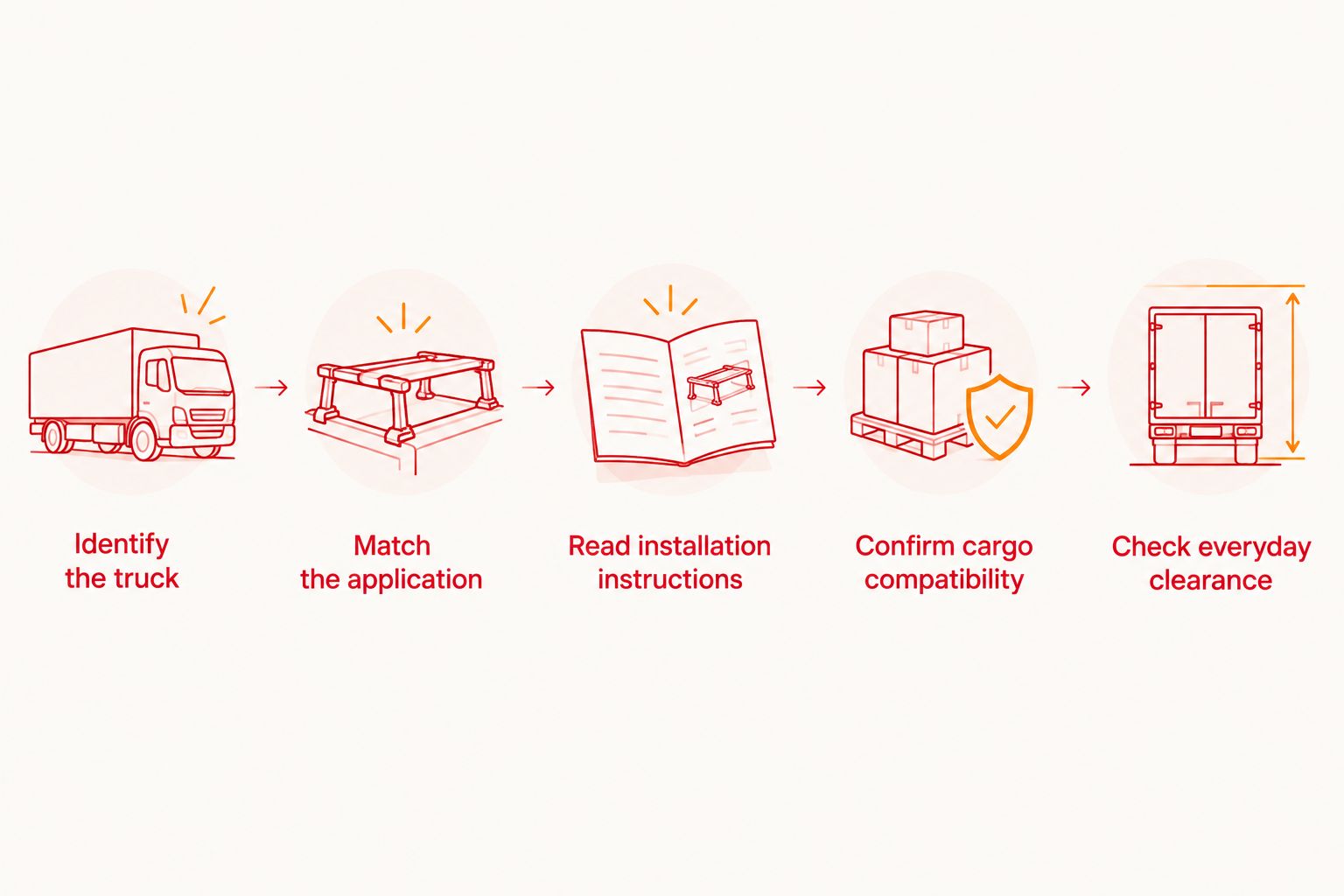
An existing roof channel or trim strip is not proof of a usable rack attachment point. Follow the instructions for the specific mounting system rather than copying a mounting method from another Tacoma.
The right rack changes with the truck and the job. Compare these factors before deciding that a larger platform or a higher advertised capacity solves your cargo needs:
Use these factors to eliminate unsuitable systems first. Comparing accessories on a rack that does not match your cab wastes time and leaves the most important question unanswered.
Use the lowest applicable limit across the vehicle, rack, mounting system, and carrier. A strong platform does not increase the Tacoma roof’s approved capacity.
Separate driving capacity from parked capacity. A parked-load statement is not a driving-load statement, and neither establishes off-road suitability without the relevant instructions.
For a 2026 Tacoma cargo plan, record the weight of every component that remains above the roof. Include mounting feet, platform or bars, carriers, accessory brackets, and the cargo itself. Check how each manufacturer defines its rating before subtracting component weights from a stated allowance.
If you are considering a rooftop tent, confirm that the complete vehicle-and-rack combination is approved for that use. Check occupied parked loading, travel loading, mounting requirements, and the tent manufacturer’s support instructions separately.
Do not use a general roof-rack rating as evidence that a tent is suitable. The tent adds both a mounting requirement and a parked-use requirement that ordinary cargo does not establish.
A daily-driver rack has to work empty as well as loaded. Consider loading access, wind noise, roof-opening operation, and clearance under your usual parking structures before committing to a configuration.
An empty rack is not a guarantee of quiet highway use. Rack shape, installation, accessories, and cargo arrangement affect airflow; follow any supplied fairing and accessory-positioning instructions rather than relying on appearance.
On trails, roof-mounted cargo also occupies space that was previously clear. Check your loaded height and keep cargo secure enough that it cannot shift into surrounding equipment.
If your 2026 Tacoma also has suspension or tire changes, measure the truck in its current configuration. A clearance measurement taken before those changes does not describe the finished vehicle.
Iron Ridge Offroad is best for truck and SUV owners shopping across aftermarket off-road part categories. Coordinate the cargo system with the rest of the build, but confirm every component’s application independently.
Build a short specification sheet you can use against the product instructions. Keep the vehicle details and cargo requirements together so that a compatible rack does not get paired with an incompatible carrier.
Your sheet should include:
For a 2026 order, use the application information for the specific part you are buying. A familiar product name or a similar-looking installation photo is not a substitute for that match.
Keep installation torque and inspection instructions with the truck’s records. Follow the manufacturer’s inspection schedule and check the system after any event that calls its condition into question.
Only use the rack on another cab when the manufacturer explicitly lists that application and specifies the required mounting parts. Shared branding or similar roof dimensions do not establish compatibility.
Check the complete assembly, not just the platform. Reusing a platform still requires an approved combination of mounts, hardware, and vehicle application.
You need a platform only when your cargo and attachment plan call for one. Compatible crossbars and a suitable carrier are another option when they support the equipment you intend to carry.
List the actual camping load first. If the equipment already travels securely inside the truck or bed, an additional roof system needs a clear purpose.
Choose the mounting location that fits your cargo, access needs, and truck configuration. A roof rack leaves the bed arrangement separate, while a bed rack requires checking bed access and cover compatibility.
Neither format wins on capacity without application-specific ratings. Compare the complete installed systems rather than isolated rack specifications.
What's the best Tacoma roof rack for a daily driver?
The best Tacoma roof rack for a daily driver is an application-matched system that carries your actual cargo without unnecessary hardware. Compare crossbars and platforms by carrier compatibility, installed weight, loading access, and parking clearance.
Will a Double Cab roof rack fit another Tacoma cab?
A Double Cab roof rack fits another cab only when the manufacturer explicitly approves that application and mounting combination. Similar dimensions do not confirm compatibility.
Can I put a rooftop tent on my Tacoma roof rack?
Use a rooftop tent only when the vehicle, rack, mounts, and tent instructions approve the complete combination. Confirm driving loads, occupied parked loads, and required tent support separately.
Does the rack's weight count toward the roof load?
The rack's weight is part of the installed roof load. Check how each applicable rating accounts for mounts, carriers, accessories, and cargo before calculating your remaining allowance.
Do all Tacoma roof racks require drilling?
Drilling requirements depend on the exact rack, mounting kit, and Tacoma application. Read the installation instructions before ordering and confirm any required sealing procedure.
Are crossbars better than a roof platform?
Crossbars are better for a compatible individual carrier; a platform is better when the cargo needs a broader attachment surface. Compare the complete system's weight and mounting requirements rather than choosing by appearance.
Will a Tacoma bed rack work with my tonneau cover?
A Tacoma bed rack works with a tonneau cover only when the specific combination is compatible. Confirm rail attachment, opening clearance, required brackets, and the exact truck-bed application.
Plan how you will unload before deciding how much you can load. Put a representative piece of cargo beside the truck and check whether you can safely reach its intended position and every attachment point.
Do that check with the Tacoma as you actually drive it, including any suspension and tire changes. A rack that fits the roof but makes routine loading impractical is the wrong setup for your daily driver.